Wandering imaginative landscapes: Part two
I began playing MMORPGs when I was undergraduate “at the turn of the twenty-first century.” This was, of course, when MMORPGs were first introduced.
Looking Back and Looking Forward
The internet for example and other ‘information’ highways’ make possible a multi-relation that open diversity up to infinity. But the advances in these areas also lead to a sort of non-reality, as for example, the ‘virtual realities’ in the domain of computer science. This is perhaps a flight response, faced with all the anxiety caused by the complexities of the Whole-World. Whatever its advantages, virtual reality is no more effective in the human imagination than a universal Esperanto would be in the area of language and expression.
--Édouard Glissant, Introduction to a Poetics of Diversity, p. 45
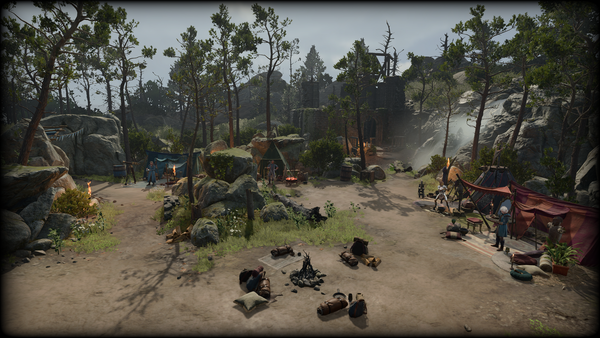
I began playing MMORPGs[1] when I was an undergraduate “at the turn of the twenty-first century.” This was, of course, when MMORPGs were first introduced. I initially played a gnome warrior named Burastikea (game-generated and with a pronunciation open to interpretation) in Everquest. I enjoyed adventuring in a 3D world and spent hours at my computer completing the quests, which were, in fact, ever-present. I even wrote an ethnography of space in the game for an anthropology course and presented it at an undergraduate research conference.
At the same time, I had my cognitive limits and prejudices. What differentiates MMORPGs from tabletop RPGs is the MMO—massively multi-player online. MMORPGs are online worlds where geography in the physical world holds no meaning. Sitting at my desk in California, I could interact with players in Tennessee, Maine, and North Carolina. I didn’t. But I could have, and I had a friend who did. He joined a guild and one night, as we were wrapping up a dinner out, he was in a rush to leave. He had to meet his guild in the Lavastorm Mountains at 8:00 p.m. (Pacific Time). I could not understand it. He didn’t even “know” these people, so why would he rush from my company to “meet” them? They weren’t real. Looking back, I think perhaps that I was a little lacking in imagination.
For Glissant, and the thinkers of the Frankfurt School and Situationists before him, my reaction would have made perfect sense. The online, the digital, the virtual, is the opposite of real. It is insincere and inauthentic. This perspective endures in our current public discourse. As a result of the increasing reliance on digital technology for communication and interaction—and decreasing opportunities (and oftentimes desire) for face-to-face interactions, fear of social atomization and alienation abounds. Hanging out—undefined social interaction in public spaces—has been replaced by social media and has made us lonely.[2] Media compresses, universalizes, subsumes diversity and richness in favor of curated escapism and false consciousness.
Thinkers of the Frankfurt School, positioned as they were between the aftermath of World War II and the middle of a profound technological revolution largely centered around industry, work, and the horrors of war, wrestled with the implications of technological advancement on social, economic, and political life. In seeking to understand newly-developing capitalist processes, Frankfurt School thinkers turned their attention to the masses, who, rather than engage in Marxist social revolution, allowed themselves to be pacified by technology, duped by a false consciousness that concealed their oppression and exploitation. Consequently, the argument goes, it was this falseness—these inauthentic social relations that capitalism was projecting onto the masses—that needed to be revealed and understood. This sounds familiar. The attention economy of the Corporate Platform Complex[3] seems well positioned to pacify us all as we wrestle with the aftermath of a global pandemic that sped up the process of digital adoption and adaptation while we simultaneously plunge head first (and seemingly without pause for contemplation of the implications) into yet another technological revolution in artificial intelligence.
Walter Benjamin emphasized the importance of an authenticity that is tied to the physical and to the here-and-now of experience, which was part of his objection to mechanical reproduction. He wrote that even in “the most perfect reproduction, one thing is lacking: the here and now of the work of art—its unique existence in a particular place.” It is a unique existence in a particular physical space that underlies authenticity, or what’s real, for Benjamin, and “[t]he whole sphere of authenticity eludes technological—and of course not only technological—reproduction.”[4]
It is with the Situationists that the question of the real and the specter of the spectacle as illusion is centered. Best & Kellner describe how “[t]hey identified consumer capitalism as a new mode of social control, as a ‘society of the spectacle,’ that pacifies its citizens by creating a world of mesmerizing images and stupefying forms of entertainment.”[5] For these thinkers, there was a direct and singular connection between media, image, and capitalist consumer society. Debord develops the idea of the spectacle, which “refers to a media and consumer society, organized around the consumption of images, commodities, and spectacles,” but, drawing on the Marxist tradition, “also refers to the vast institutional and technical apparatus of contemporary capitalism.”[6]
In attempting to delineate this spectacle, Debord claims that “[t]he spectacle is not a collection of images; it is a social relation between people that is mediated by images.”[7] He directly connects illusion to social relation and therefore social practice, arguing that “[t]he spectacle keeps people in a state of unconsciousness as they pass through practical changes in the conditions of existence…[and] reveals itself for what it is: an autonomously developing separate power.”[8] In other words, the spectacle, the mediation of social relations through technology, conceals an exploited condition of existence just as wholly as capitalist relations of production. We may think we're making meaningful connections through these digital platforms, but we're really just being pacified and distracted by the spectacle.
Art: The Language of Resistance
…the profit motive is often in conflict with the aims of art. We live in capitalism, its power seems inescapable—but then, so did the divine right of kings. Any human power can be resisted and changed by human beings. Resistance and change often begin in art.
--Ursula Le Guin, Acceptance Speech for the National Book Foundation Medal for Distinguished Contribution to American Letters
Art, too, is the language of resistance. For Benjamin, this was the physical here-and-now of gallery art and stage plays. For Glissant, art—and therefore resistance—was in the written word, specifically fiction. “I think that it is in literary works, and not in theoretical projects, that the approach to the world-totality first takes shape,” he says.[9] Fantasy novelist Ursula Le Guin would agree. Perhaps, too, would Korean essayist Hwang Bo-Reum. In 2022, Hwang wrote her first novel, Welcome to the Hyunam-Dong Bookshop. In 2024, it was translated from Korean to English and published in the United States. It tells the story of Yeongju, a workaholic who quits her corporate job and opens a small, neighborhood bookstore. The story unfolds in short vignettes, alternating in focus on the various characters, with social commentary woven throughout.
One vignette describes a book club meeting that takes place in the bookshop:
‘I feel empty too,’ said the woman in her thirties who’d just gotten a haircut. ‘The Puritan work ethic has also influenced the way we think about work—placing work on a moral pedestal. Those who work are contributing members of society; skivers are useless. It’s ridiculous that the idea of hard work as a way of gaining salvation survived centuries, crossing time and space to be passed on to people like me—a non-religious person living in twenty-first century Korea, precariously holding on to my job.[10]
Hwang uses her story to comment on capitalist social relations, describing how literature (the book the book club was discussing) travels across space and time, disseminating ideas and inciting fervent debate. Hwang’s story in and of itself is a commentary on the Puritan values of the book the story characters were discussing. It’s like literary inception. I include the excerpt here as an example of how literature can communicate values, allowing readers to imagine them, and thus creates the conditions for discussing those values and finding connections to them. Or reasons to question and resist them.
As Glissant writes,
One can’t generalize from particular values but one can quantify all these kinds of particular values, not in order to ‘extract’ universal values from them but to make them into a rhizome, a field, a cloth, a weave of values that are different but are constantly touching and intertwining with each other.[11]
Hwang’s values, expressed in her novel, intertwine with those of Glissant and of Le Guin, and in an interesting way, they touch on those of Benjamin and Debord. Glissant believed in the power of literature even as he saw it shift to an oral format. “Here, ideas…are being diffused in a way that is no longer the sensationalist diffusion of the television and the media, but the real diffusion of a change of imagination.”[12]
But what if we expand and translate Glissant’s ideas for the world we currently inhabit? This is a new world, with a new language that we must engage with. It is not the first time, after all, that we have encountered disruption. As strange as it sounds (particularly to a bibliophile like myself), the printing press was a disruptive technology when it was first invented, threatening knowledge gatekeepers and the very dissemination of ideas for which Glissant advocates. And in her speech, at the beginning of this section, Le Guin spends more of her ire on the tension between imagination and profit than on the disruption of technology. She was also willing to imagine other ways of dreaming—“There’s a good deal in common between the mind’s eye and the TV screen and though the TV set has all too often been the boob tube, it could be, it can be, the box of dreams.”[13]
And thus begins the next part of our journey. If the boob tube could become a box of dreams, could its now ubiquitous counterpart, the YouTube, become a narrative vehicle for the dissemination of ideas, of an imagination, of other ways of knowing and seeing? Perhaps. We live in its presence. We should learn its language. Our tiny humans, after all, are fluent.
[1] MMORPG stands for massively multi-player online role-playing games. They take their basic structure from tabletop RPGs in that there are different fantasy races and professions and the basic premise is that you create a group comprising diverse skill sets to accomplish the game’s objectives.
[2] This is the view of Communications and Creative Media professor Sheila Liming, who discussed her ideas on social atomization and hanging out on a podcast with New York Times journalist and political analyst Ezra Klein in 2023.
[3] Terranova, T. (2022). After the internet: Digital networks between Capital and Common. Semiotext(e).
[4] Benjamin, W. (2002). The work of art in the age of its reproducibility (E. Jephcott & H. Zohn, Trans.). In H. Eiland & M. W. Jennings (Eds.), Walter Benjamin selected writings volume 3 1935-1938 (pp. 101-133). Belknap Press. (original work written 1936 and unpublished in this form), p. 103.
[5] Best, S., & Kellner, D. (1997). The postmodern turn. Guilford Press, p. 79.
[6] Best, S., & Kellner, D. (1997), p. 84.
[7] Debord, G. (2014). Society of the spectacle (K. Knabb, Trans.). Bureau of Public Secrets. (Original work published 1967), p. 2.
[8] Debord, G. (2014), p. 9.
[9] Glissant, É. (2020). Introduction to a Poetics of Diversity (C. Britton, Trans.). Liverpool University Press. (Original work published 1996), p. 69.
[10] Hwang, B.-R. (2024). Welcome to the Hyunam-Dong Bookshop (Shanna Tan, Trans.). Bloomsbury USA. (Original work published in 2022), p. 137.
[11] Glissant, É. (2020), p. 92.
[12] Glissant, É. (2020), p. 70.
[13] This quote comes from a collection of Ursula Le Guin's non-fiction writing, Dancing at the Edge of the World: Thoughts on Words, Women, Places. I am ashamed to say that I don't know the exact page (but as soon as I find out, I'll add it!).