Wandering imaginative landscapes: Part three

One can no longer write a language monolingually. One is obliged to take into account the imaginations of the languages. These imaginations strike us through all kinds of new, unprecedented ways: audiovisual media, radio, television. When one sees an African landscape, even if one does not know the Bantu language, for instance, there is something of that language which, through the landscape we are seeing, strikes us and calls to us, even if we have never heard a single word of Bantu…One can no longer write one’s landscape or describe one’s own language monolingually. People like the Americans of the United States, who do not imagine the problematic of languages, do not even imagine the world.
--Édouard Glissant, Introduction to a Poetics of Diversity, p. 76
Languages are worlds. They are the prisms through which we make sense and meaning. Languages go beyond phonemes and morphemes and extend outward into connotations and connections and emotion. To enter into a world is to be in the presence of its semiotic systems and even if we don’t understand, those worlds call to us peripherally, sneaking tendrils into our own worlds and broadening them in ways for which we might not always anticipate or be ready.
Consider this: what if we think of communication methods as a language? This idea occurred to me while I was driving to pick up my sons from school. As much as driving in urban spaces can be a chore, it is time that I savor because it is time I spend listening to podcasts (another technological development that moves forward by moving back). It was a Wednesday and on Wednesdays I meet my younger son at the park. It means I get to sit in the car and listen longer. This particular Wednesday, I was listening to Babbage, the Economist magazine’s science and technology podcast, and the host was interviewing Charles Duhigg[1] on the topic of becoming a better communicator.[2] The host of the podcast, Alok Jha, asked Duhigg what his research has revealed about “conversations in the digital age:”[3]
Charles Duhigg (CD):
I have two teenagers and they both have their own phones because you basically can’t be a teenager without a phone these days. And this is a good question, right? And it’s oftentimes something I hear from other parents as, how do I teach my kids how to have conversations when they’re on their screen all the time and they’re never actually calling someone? Or if I’m doing Zoom meetings, how do I connect with people over Zoom?
And one of the things that I like to relate is umm what happened when telephones became popular about a hundred years ago. When phones first started having sort of mass application, there were all these articles that appeared that said no one will ever be able to have a real conversation on the telephone because you can’t see each other.
Right? Because up until that period all conversations had happened either face-to-face or through letters. And what’s interesting is that at that moment, they were actually right. That if you look at the early transcripts of telephone conversations, people used them as telegrams. They used them to send each other grocery lists or shopping orders. They didn’t know how to use the technology because it takes time to learn a technology’s strengths and weaknesses.
Now by the time you and I are teenagers, we can have conversations on the phone for like seven hours a night, right? And they feel like the most meaningful conversations in the world. Something similar is happening right now for our kids and for ourselves. We are learning how to use these new channels of communication in new ways.
And if you do have a teenager at home who has a phone, ask them at some point to show you some of their text messages that are just emojis. And ask them to decode for you what the message is there. Because what you’ll find is that our kids are using emojis as an emotional language. They’re conveying emotions through these little pictures. And they’ll say oh here’s a string of seven emojis, here's what I was telling my friend.
Alok Jha (AJ):
Can you tell me what the emotional subtexts of text messages are? Have you been let into this secret of your teenagers, of what they all mean?
CD:
Oh yeah! So, like, you know, like, I use like three emojis, right? I use the thumb up, I use the happy face. But there’s thousands of them out there and ask your kids and they use hundreds of them. And they’ll tell you oh the thumbs up is actually sarcastic, that’s what you say when you’re being sarcastic.
AJ:
Is it really? That’s news to me…
CD:
Yeah! That’s what my kids say, right? Or there’s also a difference between laughing crying and crying crying and angry crying. There’s three different emojis. And I can convey exactly what kind of emotion I’m feeling by choosing among those three. It’s a rich language that oftentimes we don’t see, but because our kids are using it so much, they learn faster than we do.
That night, I had a rare dinner out with my mama hui,[4] two friends I have known for over fifteen years. Our children are similar in age (between 10 and 15, inclusive) and have grown up together. The three of us fall on a continuum with regard to our screen use policies. I am on one end, where screens are always an option once the boys have taken care of their responsibilities. One is on the complete opposite end, where screens are strictly controlled. The third, who has the oldest child of the group, falls somewhere between us. As I am sure is true of most parents our age with children similar in age to ours, technology, screen time, and social media is a perennial topic of conversation.
Since I had just listened to the Babbage podcast, I discussed my thoughts with the hui. If we consider communication methods as registers, or even as languages, then spoken conversation, either face-to-face or on a telephone, would be our first language. It is what we grew up with and what we know. But for adults younger than we are, and certainly for our children, conversations in print, mediated through screens, is much more natural—they are much more fluent. Similar to communicating in a second language, spoken conversation (perhaps especially in person) will likely always feel more real, more authentic, and more sincere to us. When I speak to a friend of mine who is a native Korean speaker and I want to convey my sincerity, even if the entire conversation has been in English, I will repeat “truly” in Korean—정말 (jeongmal), because I’ve seen that it puts her at ease. It makes sense to me, because when we speak in Korean, which is a second language for me, I always follow my 고마워요 (gomawoyo) with “thank you.” It doesn’t feel real unless I say it in my native English.
In this way, perhaps younger generations, those born after cell phones and screen-mediated communication became ubiquitous, are simply more fluent in this communication method. It feels real to them in a way that it might never feel to us “older folk.” Perhaps we will always be a little awkward and will always need to follow up with the spoken word. But I think we must also be aware that we communicate in the presence of conversations in print. Somehow, we need to accept that communication in print is sincere and authentic communication for those for whom it is a native language.
…one of the most obvious tasks of literature, poetry and art is to contribute to the gradual ‘unconscious’ acceptance by human beings that the other is not the enemy, that what is different does not undermine me, that if I change as a result of contact with it that does not mean that I am diluting myself in the other…
--Édouard Glissant, Introduction to a Poetics of Diversity, p. 34
There is a woman I follow on Instagram. She lives in liminal proximity to me, somewhere between acquaintance and friend, because geographically, in the physical world, we are 2,000 miles apart. But we see each other every so often—our husbands being college classmates—and we keep in touch through social media. This is how we share our lives and our struggles—through pictures and posts and what Alexandra Georgakopoulou[5] calls “small stories.” It is how I have followed her efforts with her son to balance allowing him to blossom into the person he is becoming while still ensuring that he is successful according to commonly accepted metrics of teaching and learning. She posted a picture of him practicing swimming with a new swim instructor.
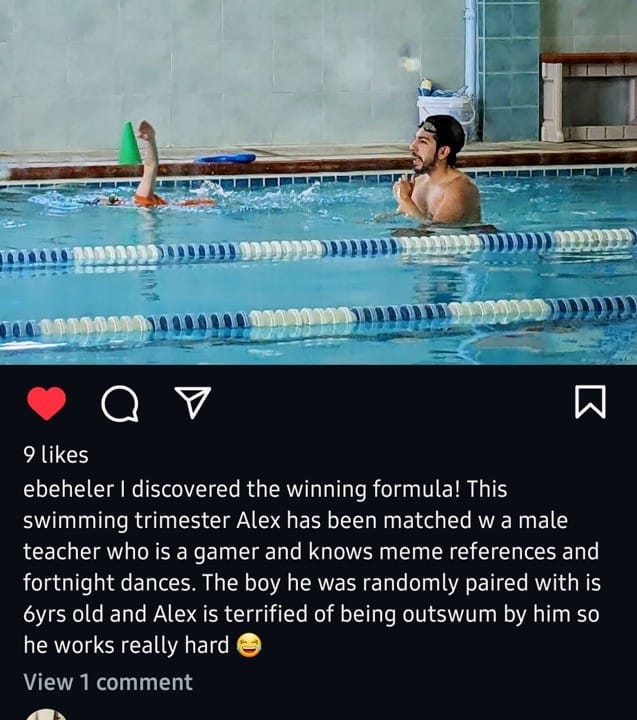
The winning formula is a teacher who speaks his language and a context that mirrors the competition of gaming.
I have always identified as both a bibliophile and a gamer. I played board games, tabletop RPGs, and video games. Video games have never seemed threatening, even if it did take me some time to think of them as spaces for connection and community. It is a familiar world, even if I immigrated there from the world of books. I’ve been a dual citizen for some time now. This is why, I think, it is relatively easy for me to understand the digital worlds that my children inhabit—to speak their language, even if it is not my mother tongue.
Whether as parents or as teachers, we have to understand these worlds and these languages in whose presence we must live and teach and learn. This is where our collective journey as a society has taken us. True, it is unexpected, new, and strange, but “what is different does not undermine” what has been and if we “change as a result of contact with it that does not mean that” we are diluted in it—we won’t lose ourselves if we learn to accept and appreciate these new digital worlds. Perhaps in learning these languages we will find connection (these kids certainly do). Perhaps in visiting these worlds we will learn to use (and model) our own imaginative strength to consider these different ways of knowing and being that our children have already begun to embrace.
[1] If you’re interested, Charles Duhigg wrote Supercommunicators, which has some interesting insights for communication in the digital age. He also has a TedTalk on YouTube if that’s more your speed. Definitely worth looking into.
[2] Jha, A. (Host). (2024, April 24). Babbage: How to be a better communicator—An interview with Charles Duhigg [Audio podcast episode]. In The Economist.
[3] I transcribed this excerpt myself, so any mistakes are my own.
[4] Hui is a Hawaiian word that is often used to mean club, association, team, and other similar concepts. It can also be used as a verb to mean to meet, intermingle, associate, or congregate. I say it was a rare dinner because three parents trying to schedule a dinner out together, without children and without spouses, is like trying to get three CEOs’ schedules to align. Something always comes up or needs to be attended to.
[5] Georgakopoulou, A. (2007). Small stories, interaction, and identities. John Benjamins.