Ayla's story: A dawning comprehension
Spoilers below. Please be forewarned.
Also, please note that I discovered a little soapbox in the middle of trying to tell this part of the story and couldn't resist climbing on top of it for a bit. It's at the end though, so you can always dig out early if that's not your thing. I'll never know. :)
Oh, and yeah, this part of the story involves sexy time. Nothing graphic, pretty vanilla, actually, but I figured I should let you know.
The grin I had on my face when the sexy time cut scene began...
I was caught off-guard by that little tryst in the woods, though. It felt quiet, intimate, and emotional. And I was completely fascinated and drawn in. By the end, it had evoked my second in-game emotion. I wish I could tell you what it was, but I don’t know a word for it. The interwebz seems to think it's compassion, but that’s not quite it. It was something that sits at the intersection of sadness, curiosity, protectiveness, and possessiveness.
Wait...whaaa? This was supposed to be conquest. Vindication! I was just there for a little sexy time fun. "I'm not the kind of girl to get messed up with you!" I just came to say hello! But Ayla, it seemed, had other thoughts.
Ayla stirred and sat up, languid and sated, blinking in the hazy sunrays filtering through the leaves. She had spent the night losing herself in Astarion’s sharp-edged sweetness, like cinnamon candies. She appreciated him—witty banter and playful flirting, haughty flattery with a halo of something dark. Her open, uncomplicated heart wasn’t looking for anything beneath those words. She wasn’t expecting anything beyond that bit of play under an open sky. Nature taking its course.
After a moment lingering over the memories, she looked up and quietly watched him. He was stark against the tall trees, his back on full display, head raised and arms outstretched, seeming to drink in the sunlight that seemed to be both bittersweet and balm. She saw an odd, circular scar that spread across his back, ridges of malice and cruelty he probably didn't want to be seen. Knowing it was script, and knowing that script to be Infernal[1], she wondered what it said, who had carved them and why.
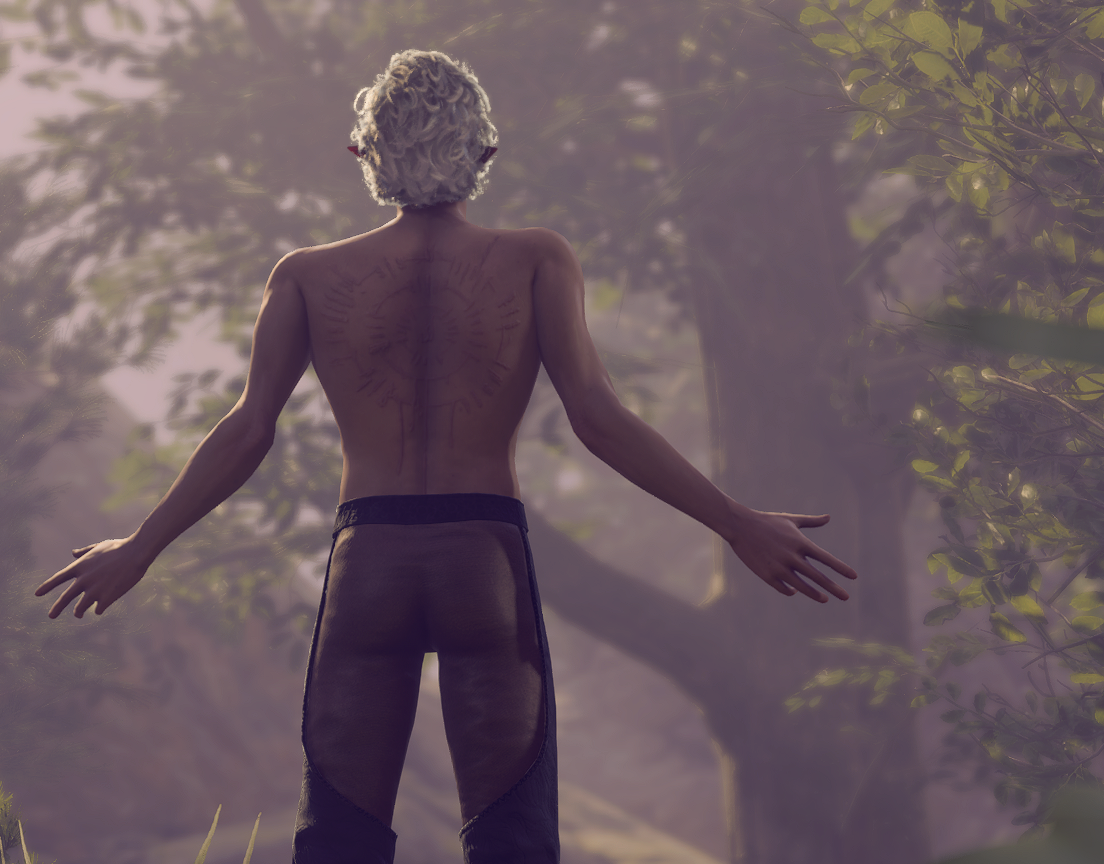
She began to sense a vulnerability, a sensitivity that must tickle and writhe beneath the playful come hither he cloaked himself with. Huh. That was unexpected. What was she missing? Should she ask about the scars? No. Better to not. Better to flit about the surface of things, as he had. Better to let him to share on his own terms, when he feels safe.
“Don’t want to come back for a cuddle?” she asked, setting aside her curiosity. He turned, surprised out of his reverie, and Ayla saw him cloak himself once more, this time with prickly disdain. It was time to head back to the group, he replied, and the ephemeral intimacy melted.
Knowing what I now know of his story, that image of Astarion the morning after is so much more poignant. What she (and I) saw at the time was a vague sense of melancholy and wonder drifting off of him. What we didn't see was everything beneath that--everything he hid beneath a sheen of sass and sarcasm. Looking back now, knowing what I know, I wonder if, in that moment, the melancholy might have been regret or resignation.
I was not expecting the poignancy of this scene. There was something about watching Astarion, mysterious scars on full display, face upturned to the sun in wonder, shoulders moving with his slow breaths, that created a knot of sorrow and lodged it just under my diaphragm. Not Ayla’s. Mine. I had no idea why something in my heart began moving so quietly, so gently. Was this the moment it ceased being a video game? Was this the moment I began to feel myself undulate between Faerûn and Hawaiʻi, a hybrid self at once Tesni and Ayla?
There's an academic article I read about about how video gaming can be an embodied experience. The author was writing about her gameplay in World of Warcraft and how it became something she felt in her body, whether she was gearing up for a raid or reflecting on interactions she had in the game with other players. I wish I could find it (I swear I have it on my computer somewhere, but my computer is the digital equivalent of Gale's wizard tower, so who knows when I'm going to come across it again), because I saw my own experience in her words. She, too, had felt game-related emotions.
Still yet, knowing this didn’t prepare me for how that scene in the woods walloped me so wholly into the narrative in such an intimate and personal way or how fully invested I would become in ensuring these characters' well-being. The experience reminded me of a younger version of myself--open, naïve, full of whimsy and wonder. I’m a grown woman now, with years of romantic (and more fun than romantic) experience behind me. How the hell is that younger version still in here?!
And yet…
I discovered as Ayla's story unfurled that this is exactly who I was. An Outlander. A country bumpkin with a soft and open heart. I discovered that Ayla is still here in me, regardless of how much I’ve grown, how much knowledge I’ve gained and wisdom I’ve earned. How many scars of my own I’ve won. What the hell?
Such a stupid game…
But I didn’t know all of this yet. All I knew at the time was that there was something deeper to this prickly vampire spawn than his pretty words and dismissive laugh. All I knew was that far from my initial goal of conquest and vindication (honestly, I had no plan after savoring that conquest), I needed to know what Astarion was hiding and why it made him so sad. I needed to figure out how to let him know he could trust me enough to tell me. I needed to make him feel safe enough to trust me. You know...Astarion approves. I needed that to find out what I wanted to know.
So yeah, knowing what I know now, Astarion, your plan totally worked, dude. The soft words, the flattery, the carefully curated gallantry--Ayla (and I, if I'm being honest) fell unthinking into it. No questions, no suspicion, just taking you at your word and responding accordingly. We were fully on your side right from the start, even as you disapproved our entire approach to life. For someone who considers herself relatively astute in her old age, deng can I still be utterly oblivious sometimes.
But, you know, I always tell the boys that when people say who they are, we should believe them, for good or ill. And we should. This is a fundamental cornerstone of my ethics (and therefore Ayla's ethics) and interweaves with the concept of epistemic justice.[2] How this belief played out in the choices and consequences of Ayla's story (now that I know its conclusion) has been so interesting to reflect on.
(And writing Ayla's story has been such a fun way to that. Thanks for coming along with me, by the way. <3 )
The thing is, some might say, well, if we take folks at their word, and believe them when they tell us who they are, we could be deceived. They could be one of those "bad actors," who are the reason we have to have fifty million different passwords that have to change every six months, which is why I never remember any of them. Or they could be, you know, trying to manipulate us or play on our sympathies--Astarion.
And yeah, that could be true. But it all washes clean in the end. The question we have to ask ourselves is which risk is greater--what we stand to lose by being wrong, or what we stand to lose by trying to exist in the world while hiding in armor?
Ayla sighed as she stood up, gathering her clothes and dressing. Astarion disappeared back into the trees and she was left wondering what that strange stirring in her stomach was. Foreboding? Disappointment at no last cuddle? Or was it something more? Wasn’t the threat of ceremorphosis enough? Would it be worse, she wondered, if she started to care about these weirdos?
[1] Wait, if a tiefling (or a warlock, for that matter) knows Infernal, why are they not able to read the scars? Why does it take Raphael and his bargain to reveal the them for what they are?
[2] Epistemic justice is a concept developed by José Medina. It is the idea that we shouldn't reject knowledge because of internalized biases against the source of the knowledge. Doing so means that everyone loses the opportunity to learn from, and enrich, each other. Medina develops it primarily from the standpoint of race and gender, but I believe the idea can be applied in many different situations--academics not trusting the validity of knowledge that emerges in popular contexts, ignoring what someone says about their gender identity, or disregarding the contributions of children in the classroom because it doesn't match the one answer that the curriculum says is correct. If you're interested in learning more, Medina's book is The Epistemology of Resistance: Gender and Racial Oppression, Epistemic Injustice, and the Social Imagination. Here's a good review. Note that the book is kind of expensive, because it's an academic book and the academic book market is a racket. But you know, your local library either has it or can get it on interlibrary loan--and we should definitely be supporting our libraries!